
BC Lakes Stewardship Monitoring Program Annual Data Review
CULTUS LAKE @ VOLUNTEER SITE
This report summarizes information collected from CULTUS LAKE @ VOLUNTEER SITE (Station ID: E335324), which is part of a group of lakes sampled at a provincial scale under the B.C. Lake Stewardship Monitoring Program (BCLSMP). BCLSMP is operated by the Ministry of Environment and Parks (ENV) in partnership with the B.C. Lake Stewardship Society (BCLSS; www.bclss.org). For more information on BCLSMP including methods, data and reports visit the program website at www.gov.bc.ca/lakestewardshipmonitoring.
CULTUS LAKE @ VOLUNTEER SITE is monitored at Level 2 and has been sampled since 2022. Level 2 studies are conducted on lakes that are also sampled by the Province under the B.C. Lake Monitoring Network (BCLMN; www.gov.bc.ca/lake-monitoring). BCLSMP data is collected by volunteer citizen scientists, with a target of 12 sampling dates per year during the open water season, and includes Secchi depths (i.e., water clarity) and temperature and dissolved oxygen profiles. BCLMN data is collected by ENV twice a year: once in late winter/spring (February to May, depending on location and ice melt) when the water column is in mixed conditions and once in the late summer/fall (August to September) when the water column is stratified. This sampling includes Secchi depths, temperature and dissolved oxygen profiles, nutrients, and algal biomass indicator (i.e., chlorophyll-a) data. When combined, these data provide information on the water quality conditions of the lake throughout the ice-free season and help understand important lake characteristics including summer oxygen depletion and productivity.
Monitoring Results
The sample results presented below are grouped into two categories: Temperature and dissolved oxygen, and water clarity.
The field data used for this review has been added to a government server for public access available through these links:
Profile data is here. Secchi data is here.
Monitoring Result summaries for the BCLMN data (i.e., chlorophyll-a, nutrients, and metals) can be found at the BC Lake Monitoring Network tab here.
2021
Lake Profiles
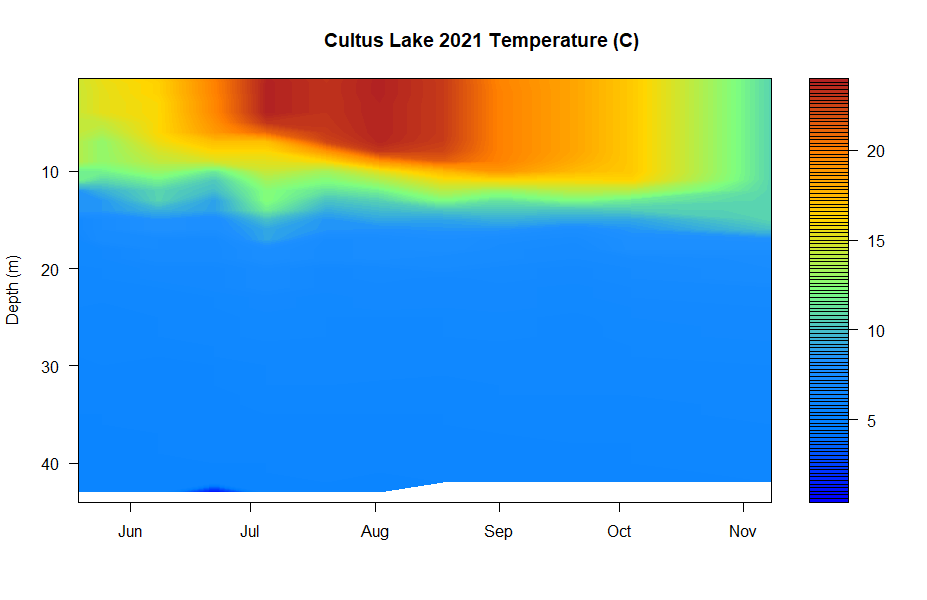
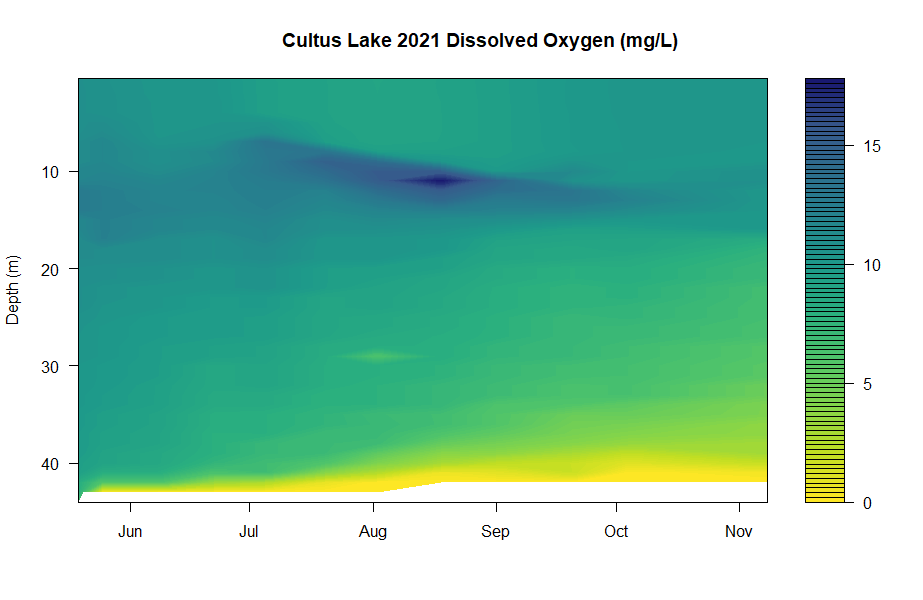
Most interior B.C. lakes stratify and form distinct layers as the air temperature warms them. The coldest water is near the bottom of a lake, and since colder water is denser it resists mixing into the warmer, upper layer for much of the summer. In early-spring and fall, these lakes typically mix from top to bottom (a process called overturn) as wind energy overcomes the temperature and density differences between surface and bottom waters. Temperature and dissolved oxygen strongly influence physical, chemical and biological processes in lakes.
Temperature (°C) and dissolved oxygen (mg/L) readings are recorded at 1 m intervals through the lake water column during each sampling event. The results of these profiles are displayed below in contour plots. Mathematical estimation, or interpolation, is used to create a plot that is easier to visualize the temperature and oxygen patterns at the sample location. This means that all the data shown in the plots between the collected sample points, both the depths and dates, are mathematically estimated from the known values before and after it. The colours in the plots represent temperature and dissolved oxygen gradients. The temperature and oxygen value that matches each colour is shown on the chart along the right side. These plots assist in understanding seasonal lake stratification patterns.
Water Clarity
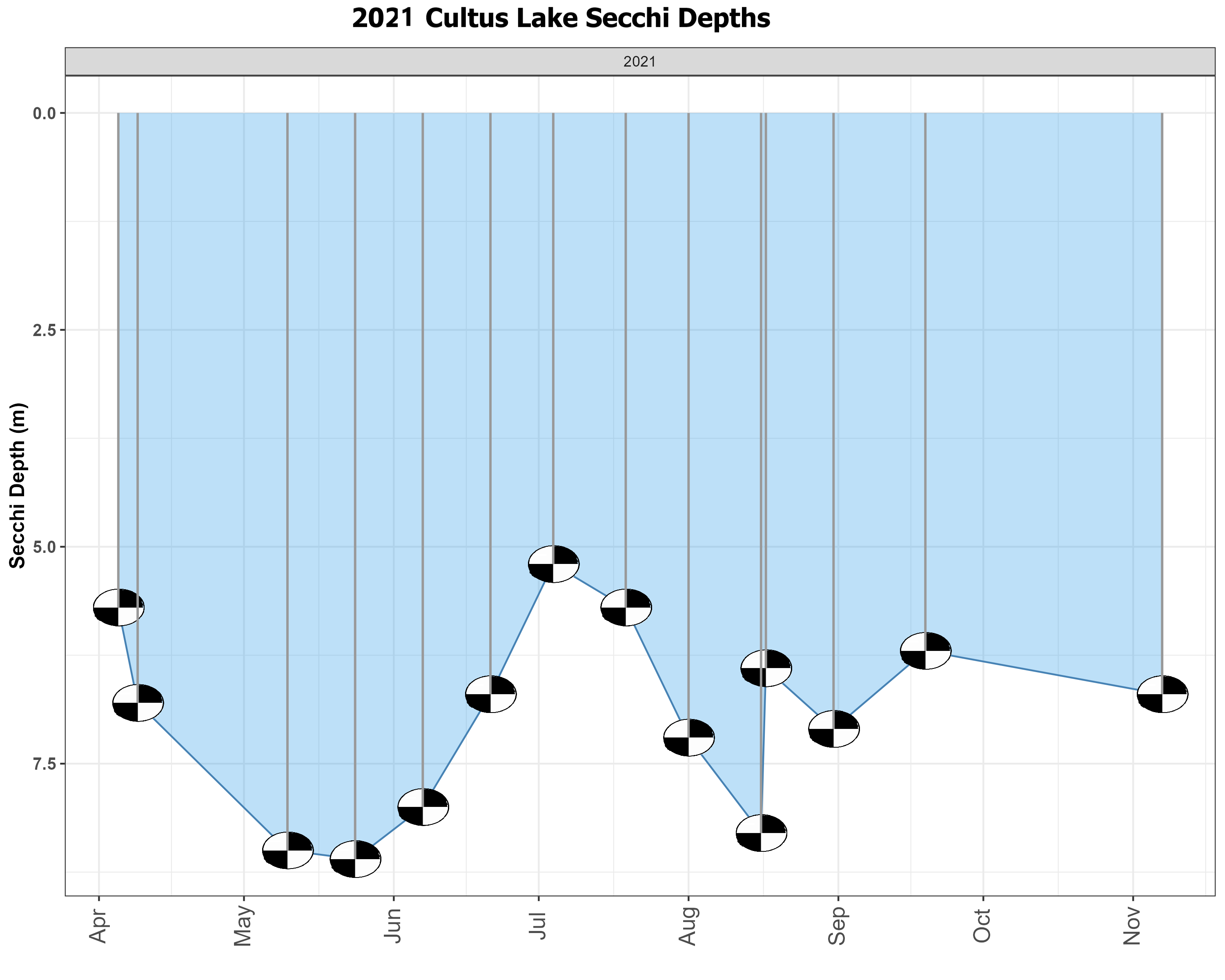
Water clarity is measured using a Secchi disk, with deeper Secchi depth indicating clearer water and shallower Secchi depth indicating less clear water. The Secchi depth can be used as an indicator of the presence of algal cells or other particles in the water column, such as pollen or sediments. The following figure shows the Secchi depths collected at each sampling event.
2022
Lake Profiles
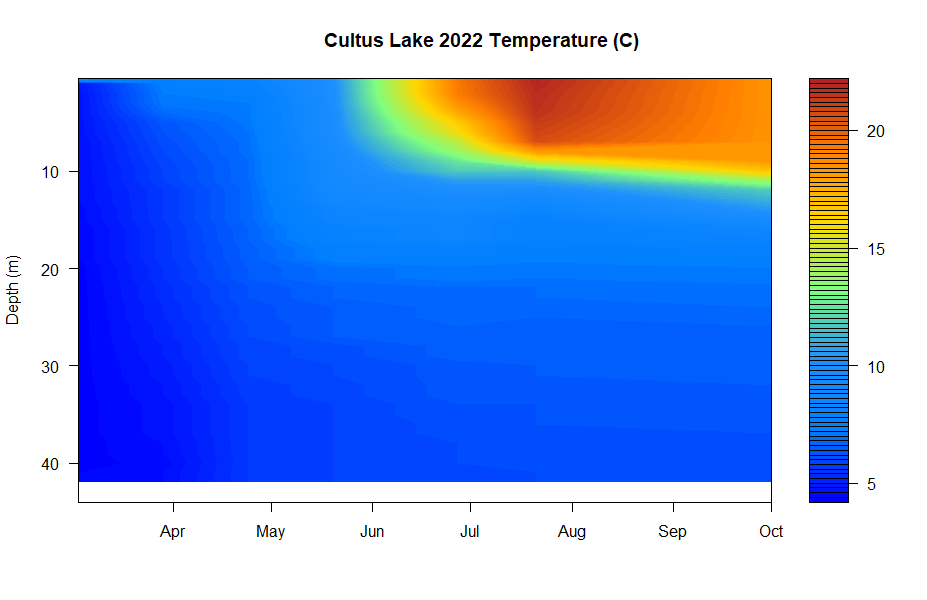
Most interior B.C. lakes stratify and form distinct layers as the air temperature warms them. The coldest water is near the bottom of a lake, and since colder water is denser it resists mixing into the warmer, upper layer for much of the summer. In early-spring and fall, these lakes typically mix from top to bottom (a process called overturn) as wind energy overcomes the temperature and density differences between surface and bottom waters. Temperature and dissolved oxygen strongly influence physical, chemical and biological processes in lakes.
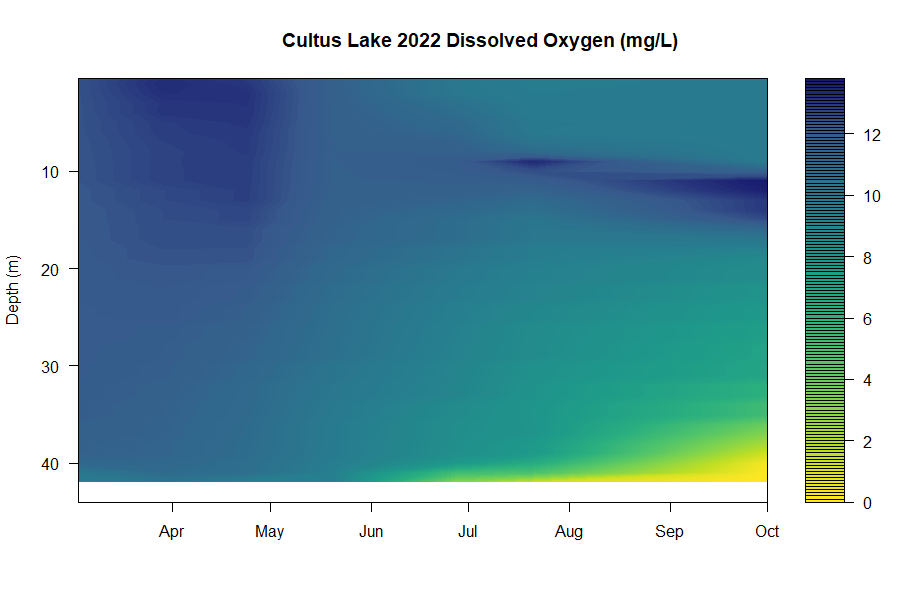
Temperature (°C) and dissolved oxygen (mg/L) readings are recorded at 1 m intervals through the lake water column during each sampling event. The results of these profiles are displayed below in contour plots. Mathematical estimation, or interpolation, is used to create a plot that is easier to visualize the temperature and oxygen patterns at the sample location. This means that all the data shown in the plots between the collected sample points, both the depths and dates, are mathematically estimated from the known values before and after it. The colours in the plots represent temperature and dissolved oxygen gradients. The temperature and oxygen value that matches each colour is shown on the chart along the right side. These plots assist in understanding seasonal lake stratification patterns.
Water Clarity
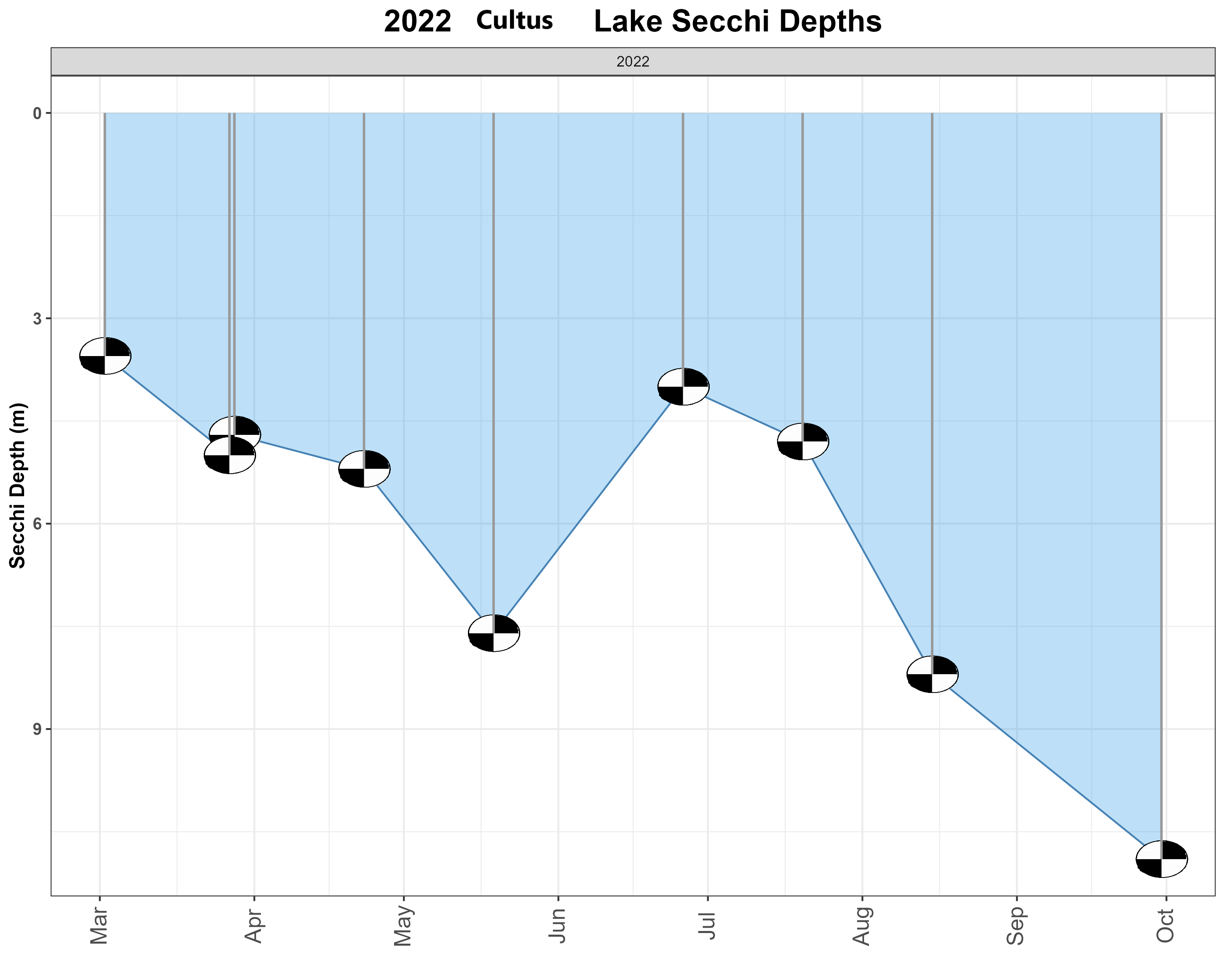
Water clarity is measured using a Secchi disk, with deeper Secchi depth indicating clearer water and shallower Secchi depth indicating less clear water. The Secchi depth can be used as an indicator of the presence of algal cells or other particles in the water column, such as pollen or sediments. The following figure shows the Secchi depths collected at each sampling event.
2023
Lake Profiles
Most interior B.C. lakes stratify and form distinct layers as the air temperature warms them. The coldest water is near the bottom of a lake, and since colder water is denser it resists mixing into the warmer, upper layer for much of the summer. In early-spring and fall, these lakes typically mix from top to bottom (a process called overturn) as wind energy overcomes the temperature and density differences between surface and bottom waters. Temperature and dissolved oxygen strongly influence physical, chemical and biological processes in lakes.
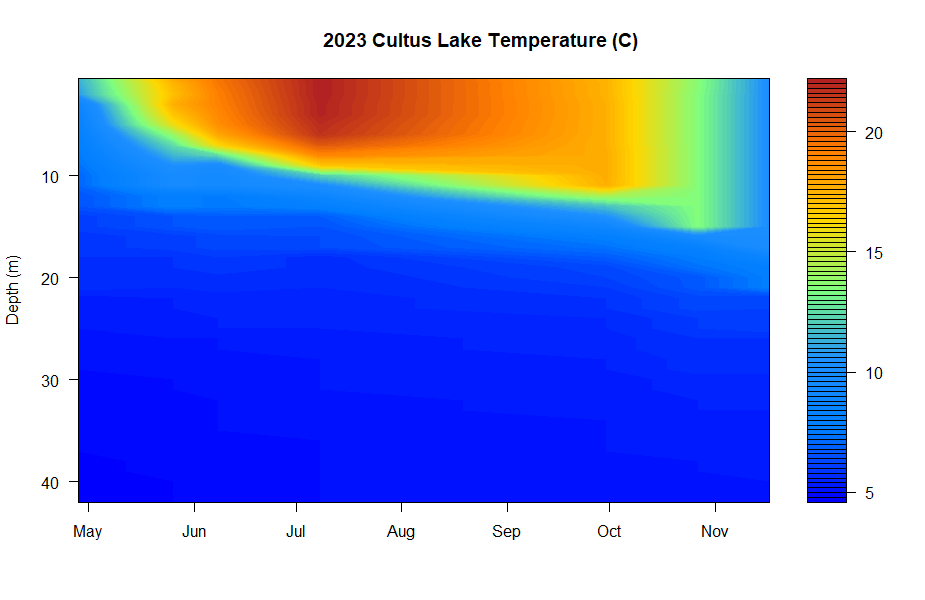
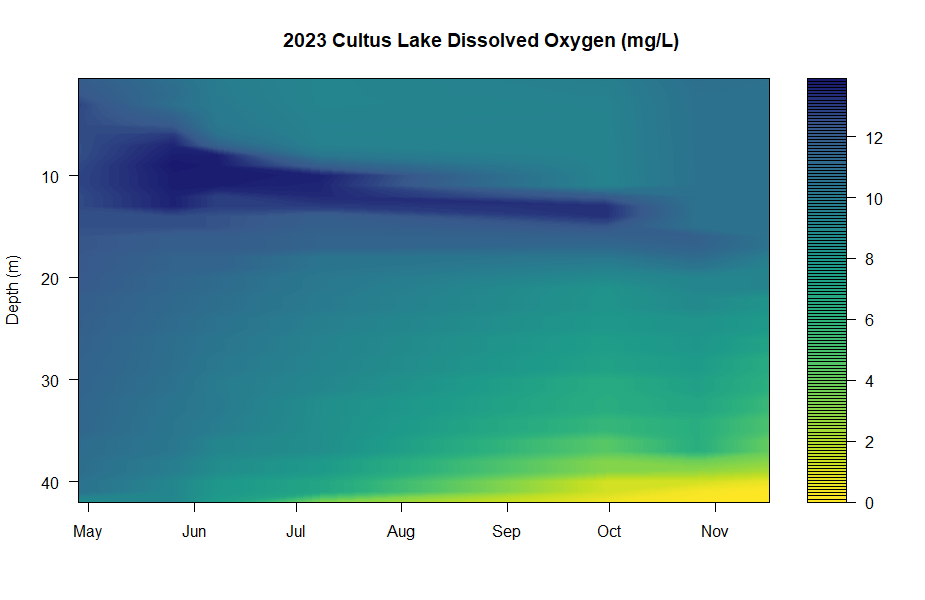
Temperature (°C) and dissolved oxygen (mg/L) readings are recorded at 1 m intervals through the lake water column during each volunteer sampling event. The results of these profiles are displayed below in contour plots. Mathematical estimation, or interpolation, is used to create a plot that is easier to visualize the temperature and oxygen patterns at the sample location. This means that all the data shown in the plots between the collected sample points, both the depths and dates, are mathematically estimated from the known values before and after it. The colours in the plots represent temperature and dissolved oxygen gradients. The temperature and oxygen value that matches each colour is shown on the chart along the right side. These plots assist in understanding seasonal lake stratification patterns.
Water Clarity
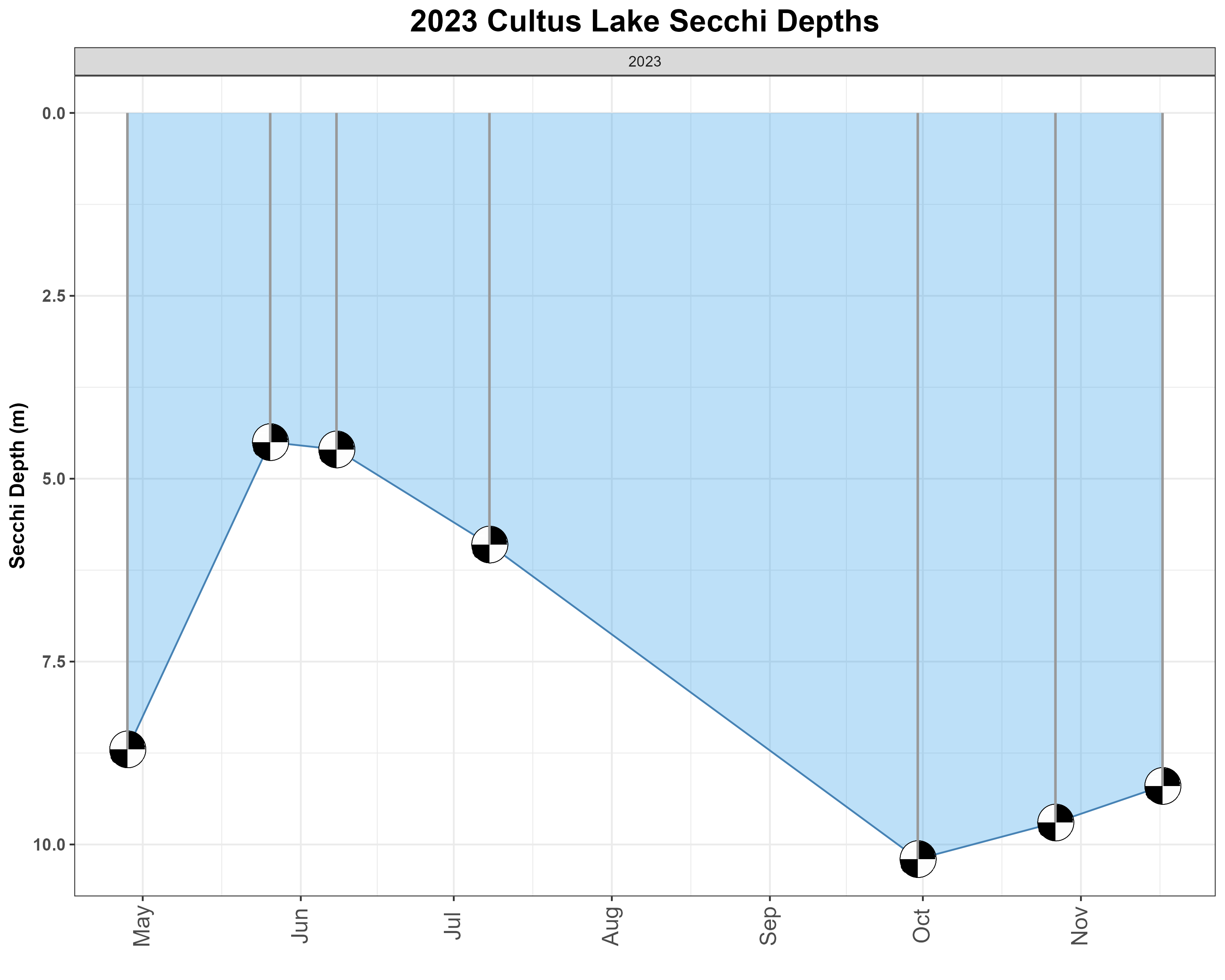
Water clarity is measured using a Secchi disk, with deeper Secchi depth indicating clearer water and shallower Secchi depth indicating less clear water. The Secchi depth can be used as an indicator of the presence of algal cells or other particles in the water column, such as pollen or sediments. The following figure shows the Secchi depths collected at each sampling event.
2024
Lake Profiles
Most interior B.C. lakes stratify and form distinct layers as the air temperature warms them. The coldest water is near the bottom of a lake, and since colder water is denser it resists mixing into the warmer, upper layer for much of the summer. In early-spring and fall, these lakes typically mix from top to bottom (a process called overturn) as wind energy overcomes the temperature and density differences between surface and bottom waters. Temperature and dissolved oxygen strongly influence physical, chemical and biological processes in lakes.
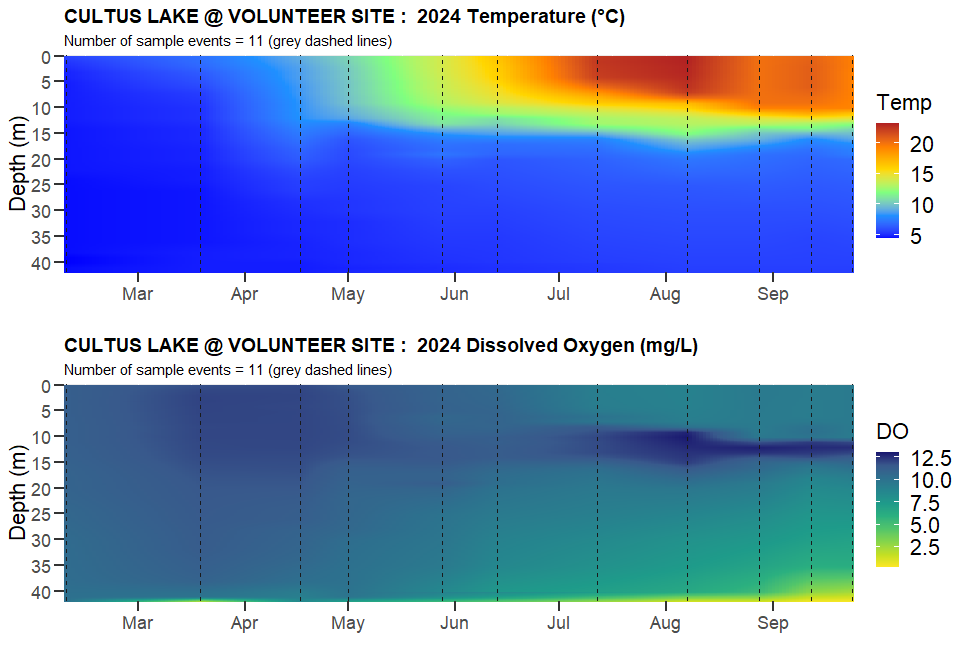
Temperature (°C) and dissolved oxygen (mg/L) readings are recorded at 1 m intervals through the lake water column during each volunteer sampling event. The results of these profiles are displayed below in contour plots. Mathematical estimation, or interpolation, is used to create a plot that is easier to visualize the temperature and oxygen patterns at the sample location. This means that all the data shown in the plots between the collected sample points, both the depths and dates, are mathematically estimated from the known values before and after it. The colours in the plots represent temperature and dissolved oxygen gradients. The temperature and oxygen value that matches each colour is shown on the chart along the right side. These plots assist in understanding seasonal lake stratification patterns.
Water Clarity
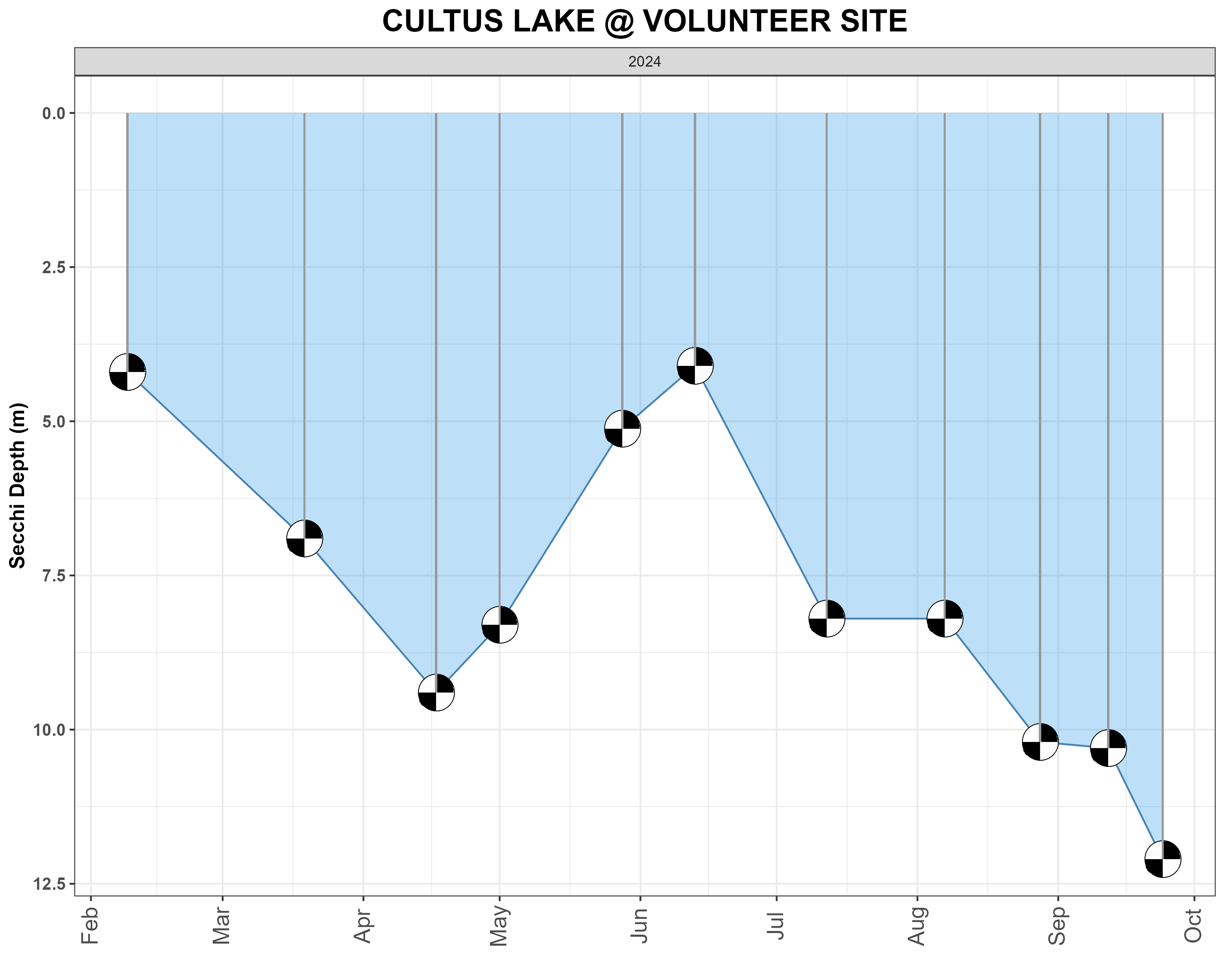
Water clarity is measured using a Secchi disk, with deeper Secchi depth indicating clearer water and shallower Secchi depth indicating less clear water. The Secchi depth can be used as an indicator of the presence of algal cells or other particles in the water column, such as pollen or sediments. The following figure shows the Secchi depths collected at each sampling event.
2025
Lake Profiles
Most interior B.C. lakes stratify and form distinct layers as the air temperature warms them. The coldest water is near the bottom of a lake, and since colder water is denser it resists mixing into the warmer, upper layer for much of the summer. In early-spring and fall, these lakes typically mix from top to bottom (a process called overturn) as wind energy overcomes the temperature and density differences between surface and bottom waters. Temperature and dissolved oxygen strongly influence physical, chemical and biological processes in lakes.
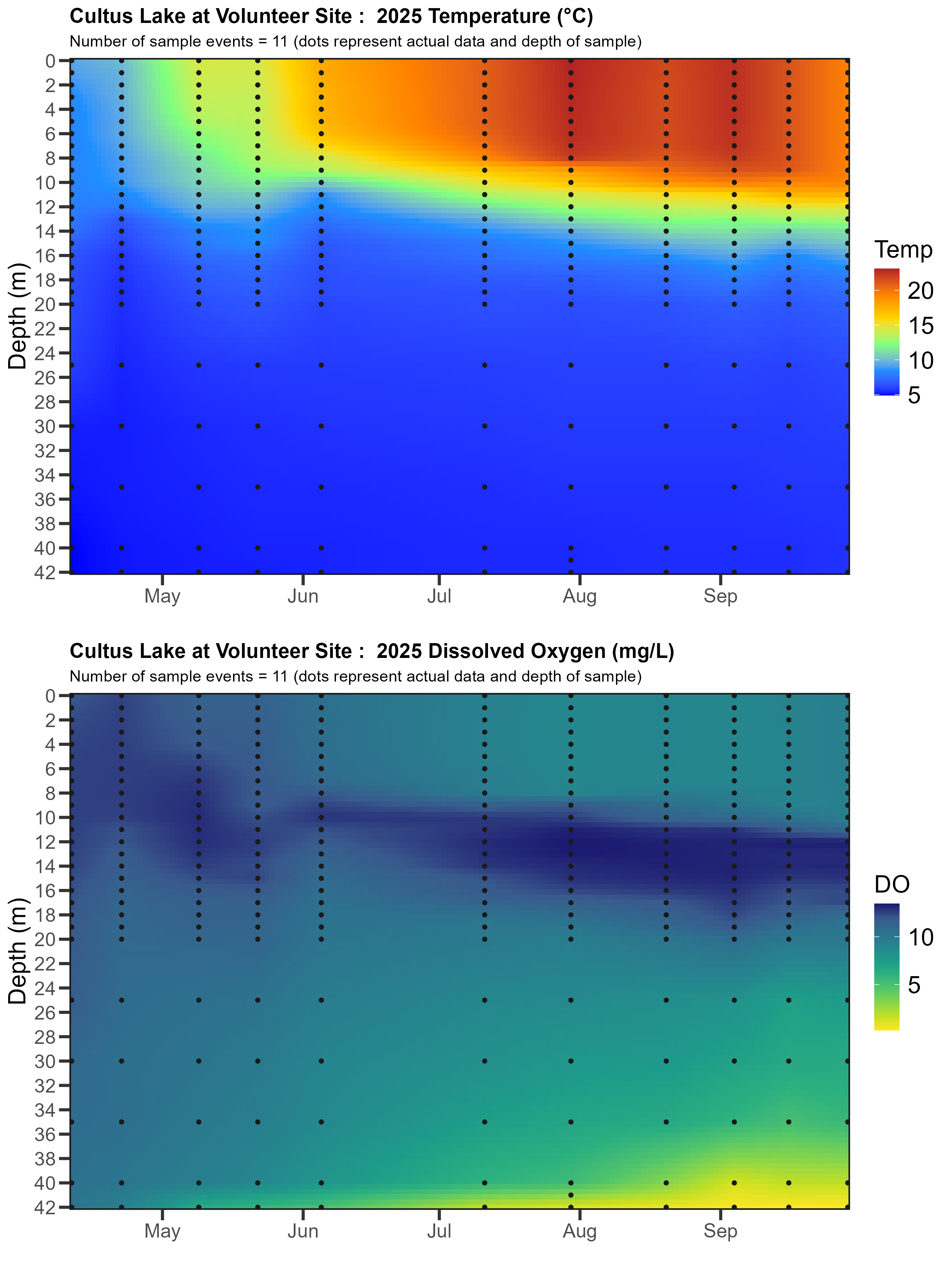
Temperature (°C) and dissolved oxygen (mg/L) readings are recorded at 1 m intervals through the lake water column during each volunteer sampling event. The results of these profiles are displayed below in contour plots. Mathematical estimation, or interpolation, is used to create a plot that is easier to visualize the temperature and oxygen patterns at the sample location. This means that all the data shown in the plots between the collected sample points, both the depths and dates, are mathematically estimated from the known values before and after it. The colours in the plots represent temperature and dissolved oxygen gradients. The temperature and oxygen value that matches each colour is shown on the chart along the right side. These plots assist in understanding seasonal lake stratification patterns.
Water Clarity
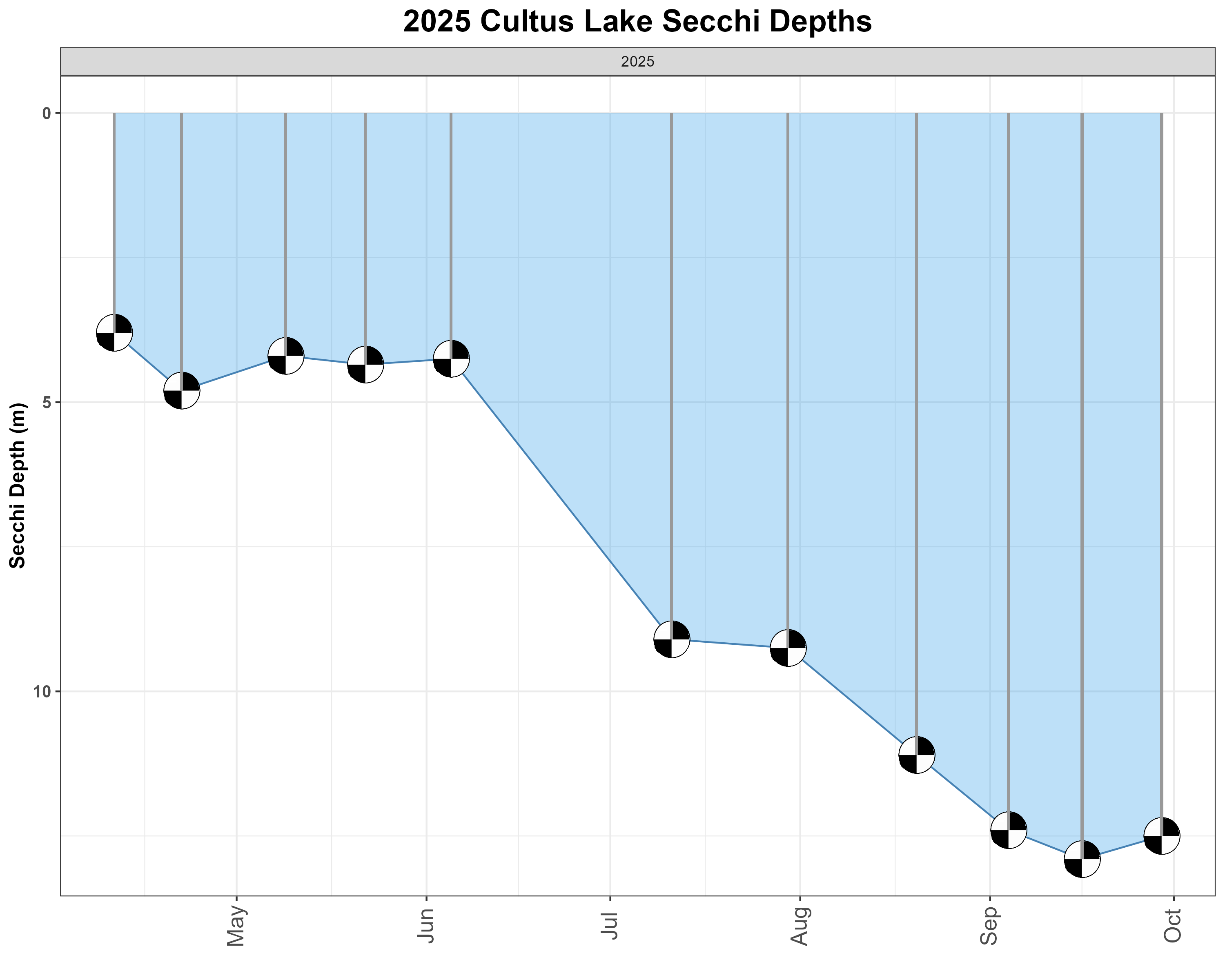
Water clarity is measured using a Secchi disk, with deeper Secchi depth indicating clearer water and shallower Secchi depth indicating less clear water. The Secchi depth can be used as an indicator of the presence of algal cells or other particles in the water column, such as pollen or sediments. The following figure shows the Secchi depths collected at each sampling event.
Disclaimer
This document provides a brief summary of annual sampling data but does not include an interpretation of results. Full reports, which include data interpretation, are published upon completion of each sampling program. For access to published reports visit the B.C. Lakes Stewardship Society (BCLSS) library here.
For further information, or to volunteer as a lake sampler, please mail volunterlakes@gov.bc.ca.
Web Browser Support
To view the interactive map, graphs, and reports, you must use an up-to-date version of one of these browsers: Chrome™, Firefox®, Microsoft Edge, or Safari. Reports and graphs may not display for Windows 7, Internet Explorer 11 users
